When most people think about getting stronger, they think about what they can lift. But there's a different way to define strength — one that has less to do with a number and more to do with how your body feels at 70.
Functional longevity strength is the ability to move freely, recover well, maintain balance, and stay out of pain as you age. It's the kind of strength that protects your joints, keeps your posture from collapsing, and lets you bend down to pick something up without bracing for impact.
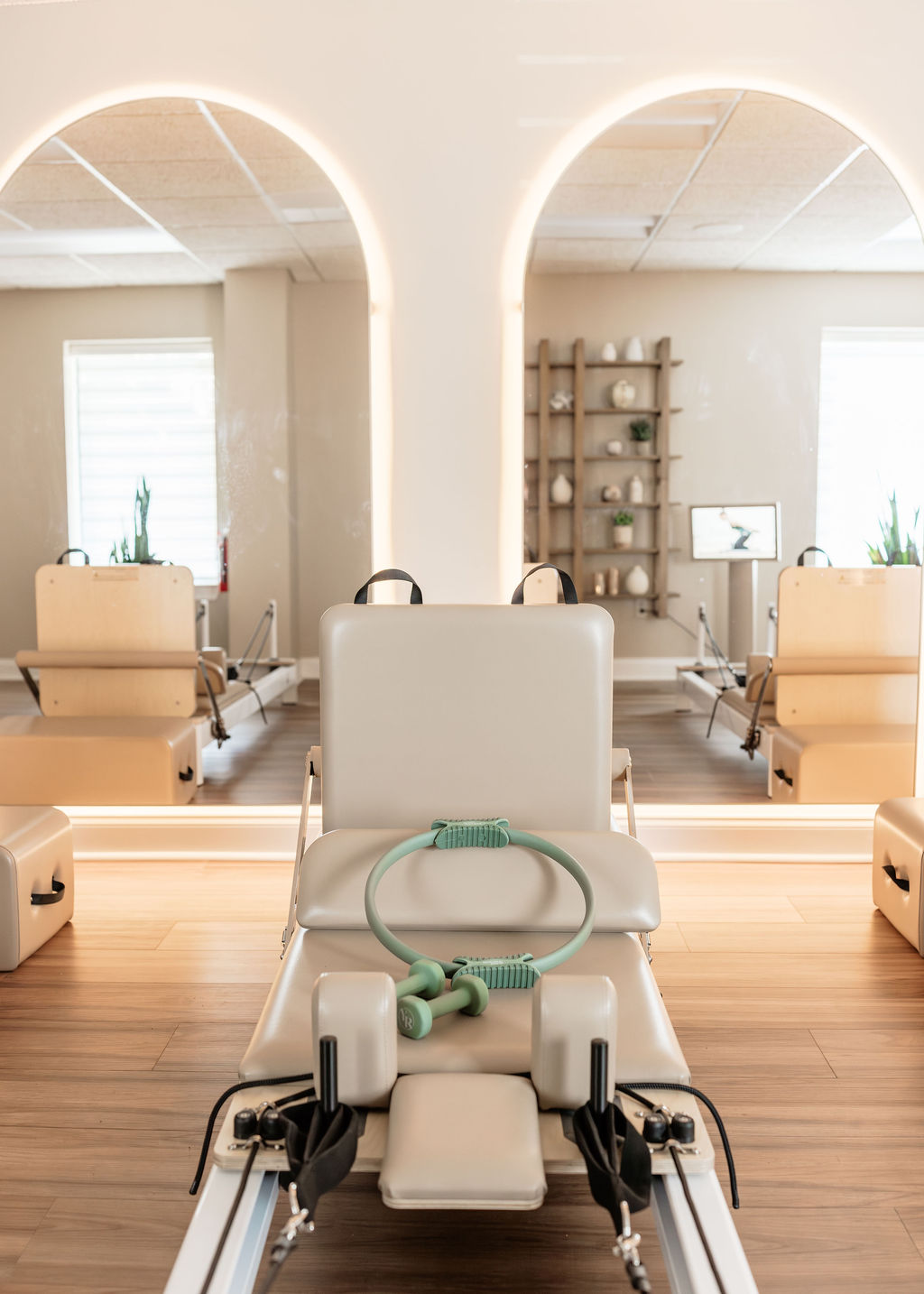
This is the kind of strength we focus on at Balanced Body Pilates.
Most gym-based strength training focuses on prime movers — the big, visible muscles that lift heavy loads. Quads, glutes, lats, chest. These muscles matter, but training them in isolation creates an imbalanced body.
The stabilizing muscles — the rotator cuff, the deep hip stabilizers, the pelvic floor, the multifidus — are the framework your body hangs on. When they're weak, the prime movers compensate. That compensation is silent until it isn't: a disc injury, a knee that starts clicking, a shoulder that won't stop aching.
Pilates trains the stabilizers first. Every exercise starts from a stable foundation before asking for range of motion or load. It's deceptively difficult if you've spent years bypassing those muscles entirely.
A mobile spine is a healthy spine. Pilates emphasizes spinal articulation in both directions — flexion, extension, rotation, and lateral flexion — which keeps the discs hydrated, the muscles supple, and the nervous system responsive. Most adults live in a single plane of motion (seated, looking forward). Pilates systematically works you out of that pattern.
The hips are the body's power center and shock absorber. When hip stabilizers are weak, the knees take over — and they weren't designed for that job. Pilates side-lying series, footwork on the reformer, and single-leg work all target the hip abductors, external rotators, and glute medius in ways that transfer directly to walking, stairs, and daily life.
"Core" is an overused word, but Pilates uses it precisely. The core isn't just the abs — it's the entire cylinder of muscles that supports the spine: pelvic floor below, diaphragm above, deep abdominals in front, and multifidus behind. Pilates teaches these to work as a unit, not in isolation. When this system works correctly, the spine is supported from the inside out.
Falls are one of the leading causes of injury in adults over 60. Balance isn't a fixed trait — it's a skill that degrades without practice and improves with consistent training. Pilates progressively challenges balance through single-leg exercises, unstable surfaces, and movement sequences that require coordination and body awareness.
What we love about Pilates as a longevity tool is that it scales. You can start at any age, any fitness level, and make meaningful progress. It doesn't require impact, heavy loads, or heroics. It requires consistency, attention, and a willingness to move with care.
The clients we see making the most transformative changes are often those who've never thought of themselves as "fitness people." They start because of back pain, or a physical therapist's recommendation, or simple curiosity. They stay because of how they feel.
Interested in building functional strength that lasts? Learn more about our class formats or get in touch. We offer classes in Hammonton, NJ for all levels and experience backgrounds.